


"One Hundred Years of Solitude" in Sixteen Brilliant Episodes

When I was in the sixth grade, my family moved into a new home in Phoenix, Maryland and the previous owners had left a small reading room in a Harry Potter-style cubby under the basement stairs. Visiting the cubby became a favorite pastime of mine and I soon discovered J.R.R. Tolkien's The Lord of the Rings in the inherited dusty paperback collection that lined the shelves down there. I am both embarrassed and delighted to remember the level of obsession the book created in me. I would hike through the woods pretending to be an elf. I bought cheap cinnamon swirl pastries at the local High's Ice Cream shop and picnicked on a rock worn smooth by the nearby Gunpowder River, pretending I was on my own quest and eating lembas bread to sustain me through the ordeals ahead—presumably involving orcs and wizards.
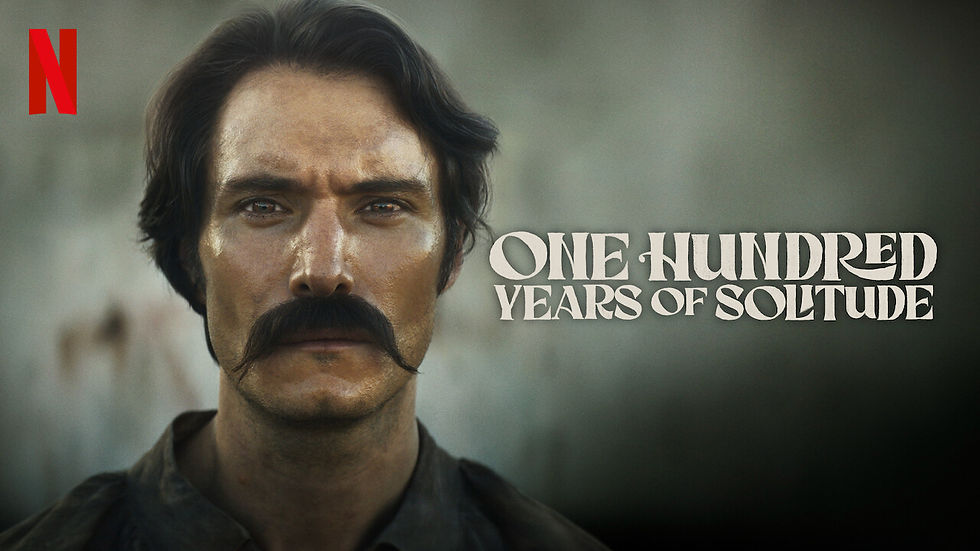
In addition to steering me towards my career as a librarian, this memory also created an obsession that I still have today: to immerse myself in a literary world so completely realized that it feels like a parallel universe. Ironically, some books haunt you because they leave you with as many questions as they answer and some novels are inherently resistant to adaptation. Gabriel García Márquez’s One Hundred Years of Solitude is one of them. It is intentionally vast, circular, symbolic, strange, intimate, political, funny, and devastating. Netflix’s Spanish-language series—available with English subtitles or English audio—takes on that challenge with rare seriousness and I encourage you to watch it for yourself. It does not try to turn the book into a simple family drama. It lets the story breathe, even when that means moving slowly. What may initially seem like a distinctly Latin American story eventually feels much less foreign. García Márquez's warning about historical amnesia—the way families and nations repeat what they refuse to understand—has uncomfortable resonance well beyond Colombia, including in our own current American political life.
I've read the book once and watched the series twice (once in English and once in Spanish) but I ended up needing to do some research to maximize my understanding. To that end, below are a few observations that I hope will make the experience of reading or watching One Hundred Years of Solitude a little less frustrating. Because this story is beautiful. Confounding, terrifying, strangely reassuring, and well worth the investment.
The best thing about Netflix’s adaptation is that it respects the book’s unusual movement. The story does not build like a normal plot, where each event clearly leads to a climax. It moves in loops. Names return. Desires return. Mistakes return. A character may seem central, then vanish into memory. A small image can matter as much as a war.
That can make the show demanding. Viewers who want a fast, clean story may struggle with the repeated names and long family history. The series asks for attention. It also rewards that attention. The repetition is the point. The Buendías do not simply make bad choices. They live inside patterns they barely understand.
The adaptation’s pacing works best when it trusts silence and atmosphere. Scenes in the Buendía home often carry more weight than speeches. Úrsula walking through rooms, Aureliano making tiny goldfish, or the town gathering around some strange new arrival can say as much as dialogue.
The Idea That Unlocked It for Me
The novel suggests that people and societies are doomed to repeat their mistakes when they become isolated from one another and fail to remember or understand their past.
The more I thought about the book, the more I came to see solitude, memory, and repetition as inseparable. The Buendías aren't simply doomed because they make bad decisions. They become trapped because they cannot fully connect with one another, understand what came before them, or recognize the patterns they are repeating.
Summary I thought that my family was idiosyncratic, but this one takes the cake. The story begins with cousins José Arcadio Buendía and Úrsula Iguarán, who marry, leave their old life behind, and found Macondo. At first, the town feels untouched by the wider world—a place of invention, superstition, desire, and wonder. Gypsies arrive with magnets, ice, and seemingly impossible ideas. José Arcadio becomes increasingly obsessed with knowledge and discovery, while Úrsula becomes the force that keeps the family grounded.
From there, the story expands across generations of the Buendía family as children inherit names, traits, desires, wounds, and mistakes. Macondo changes alongside them, gradually encountering religion, politics, war, technology, industry, capitalism, and foreign influence. At the center of everything is the Buendía house, where names, personalities, desires, and mistakes seem to return again and again. What initially feels confusing gradually reveals one of García Márquez’s central ideas: history—whether the history of a family or a country—has an unsettling tendency to repeat itself.
When all is said and done, the novel can be understood on several levels:
As a family saga: the history of the Buendía family.
As the story of a place: the rise and transformation of Macondo.
Historically: a reflection of Colombia and, more broadly, Latin America.
Symbolically: a story with a biblical arc, from an Eden-like creation through sin, exile, destruction, and apocalypse.
A Few Things That Helped Me Understand Macondo
It can be unsettling to encounter art that resists easy understanding, but those are often the works that haunt me most—and challenge me to look deeper. The Netflix series helped me better interpret the novel, but I also spent more than a little time quizzing ChatGPT and Google about what, exactly, García Márquez was doing. Here are a few ideas that finally helped calm the waters of my very curious—and occasionally overwhelmed—mind.
What Does “Solitude” Actually Mean?
In One Hundred Years of Solitude, solitude is both a good thing and a bad thing—but García Márquez ultimately presents it as dangerous when it turns into isolation.
For the Buendía family, solitude can initially be something positive. It gives characters independence, privacy, creativity, and even intellectual freedom. José Arcadio Buendía, for example, withdraws into his experiments and imagination. Colonel Aureliano Buendía’s solitude gives him a kind of emotional self-sufficiency. Several characters seem most comfortable when they are alone.
But the novel gradually shows the cost of that solitude. The Buendías repeatedly fail to form lasting emotional connections. They love people, but often cannot truly communicate with them. They retreat into obsessions, memories, pride, war, work, sex, or nostalgia instead of breaking through to one another.
That is why the title is so important. The “solitude” isn't simply being alone. It is more like an inability to escape oneself and genuinely connect with other people.
Understanding Magical Realism The "magical realism" that is so common in Latin literature is worlds away from Tolkien's magic. Magical realism is one of the most important features of One Hundred Years of Solitude. Gabriel García Márquez presents supernatural events as if they are completely ordinary, allowing the magical and the realistic to exist side by side. Characters encounter ghosts, prophetic dreams, impossible weather, and even a woman who rises into the sky, yet these events are described in the same calm tone as everyday life. This style reflects the way myths, religion, memory, and history can all shape how people understand reality.
Ironically, the Shire and the One Ring always seemed realistic to me but the miracles of Macondo hit me as glaring and full of WTF?! Things finally clicked for me when I stopped trying to determine whether the strange things happening in Macondo were supposed to be “real.”
Magical realism also helps García Márquez explore the history and culture of Latin America. Extraordinary events often appear alongside war, political violence, family conflict, and social change, making real historical experiences seem almost as unbelievable as the supernatural ones. By blending fact and fantasy, García Márquez shows how memory can distort the past and how people sometimes accept incredible stories while ignoring painful truths. In this way, magical realism strengthens the novel’s themes of memory, solitude, repetition, and the difficulty of separating history from myth.
Yes, the Names Are Supposed to Be Confusing
The character names in One Hundred Years of Solitude are intentionally confusing because Gabriel García Márquez wants the generations of the Buendía family to seem as though they are repeating one another. Names such as José Arcadio and Aureliano appear again and again, and the characters who share those names often share similar personalities and behaviors. The José Arcadios tend to be more impulsive, physical, and passionate, while the Aurelianos are usually more thoughtful, withdrawn, and solitary. Reusing the names makes the reader experience the same sense of repetition that defines the family’s history. The men frequently disappear into reckless pursuits, obsessions, wars, and adventures, while the women are more often left to hold the home and family together.
The confusion also supports one of the novel’s main themes: people who fail to understand the past are likely to repeat it. As generations blur together, it becomes harder to distinguish one Buendía from another, just as the family itself struggles to learn from previous generations. García Márquez therefore makes the reader work to keep track of the characters on purpose. The repeated names turn the family history into a cycle and reinforce the idea that the Buendías are trapped by patterns they cannot escape.
Netflix’s One Hundred Years of Solitude is a rare literary adaptation that understands reverence is not enough. It needs shape, silence, heat, grief, and patience. The series gives the Buendía family a world that feels alive, then lets that world collapse under the weight of everything it refused to remember.
It is not always easy viewing, but it is rich, haunting, and worth the time. For anyone willing to follow the circles of Macondo, the series stands as a thoughtful and emotionally powerful version of García Márquez’s masterpiece.


Comments